
What Are Titles Costing You?
The Case for Functions Over Titles
“Rank does not confer privilege or give power. It imposes responsibility.”
— Peter Drucker
Six months in, the leadership team sat across from their new COO with the same unspoken question: Why isn’t this working?
The Founder wanted someone running day-to-day operations. Finance expected a systems builder. Sales assumed he would own fulfillment. The board thought they had hired a strategic number two.
Same person. Same title. Four completely different jobs.
This is not an unusual story. It is what happens when titles are asked to do the work of clarity.
The company had been growing quickly. Cracks were forming. Execution was slipping. Everyone agreed they needed help bringing order to the chaos so the business could scale.
They were aligned on the pain.
They were not aligned on the work.
So they agreed on a title: COO.
The problem was not the person.
The work had never been defined.
The Hidden Cost of Titles
A title is never just a label. It is a claim on status, authority, and compensation, whether you meant it that way or not.
Inside an organization, a title immediately triggers assumptions about decision rights, access, and hierarchy. None of this is written down. All of it is felt.
That might be manageable if titles were consistent. They are not.
A VP at one company may run a hundred-person team. At another, the same title belongs to the first hire in a function. Same label. Completely different scope.
Leaders believe they are aligned because they agree on the title. They are most often not. Each person is carrying a different picture of responsibility and authority, and that difference stays hidden until decisions need to be made or someone asks the inevitable question:
Who actually owns this?
By then, the cost is already being paid.
Ego enters quietly. Identity attaches to the title. Conversations shift from defining ownership to defending status.
I watched a VP sit in silence during a restructuring meeting, arms crossed. A lateral move felt like losing face, even though the new role was better for the business and better for her.
Leaders find themselves managing emotions instead of making clear decisions.
Titles give the appearance of structure. Too often, they create confusion that stays invisible until it becomes expensive.
Where Titles Do the Most Damage
When titles replace clarity, the damage shows up in predictable places.
Hiring confusion. Teams align on a title but not on the scope of the role. Candidates walk into misalignment before day one, and leaders don’t realize it until performance breaks down.
Restructuring paralysis. Necessary changes feel personal. A lateral move feels like a demotion. Leaders hesitate, not because the structure is unclear, but because the status implications are.
Compensation tension. Pay gets anchored to labels instead of responsibility. Conversations drift away from value and toward entitlement.
Identity battles. Titles stop describing work and start defining people. Feedback feels threatening. Growth slows because progress is measured by title changes instead of impact.
These are not edge cases. They are the predictable consequences of building structure on unstable labels.
Functions Over Titles
The solution is not better titles. It is defining the work before you label it.
Instead of starting with a title, start with the function. Ask the question that actually matters:
What does the business need owned here?
Define the work, then label it. Never the reverse.
For each function, define two things:
The name of the function
Three to seven accountabilities that define the scope of responsibility
These are not task lists. They describe what the function is accountable for, not how the work gets done.
Write them as nouns.
Nouns define accountability. Verbs describe activity. Nouns describe what is owned.
Revenue vs. managing revenue. Pipeline vs. building pipeline.
The first creates ownership. The second creates confusion.
Example: Sales
Revenue
Pipeline
New Clients
Account Management
Team Leadership and Management
This makes one thing clear: what the Sales function is accountable for.
Execution-level functions can then be defined beneath it, each with their own scope.
Example: Account Executive
Lead Generation
Needs Assessment
Capabilities Presentation
Contract Execution
Relationship Management
This creates clarity between leadership and execution. No overlap. No ambiguity.
A simple visual makes this easier to see.
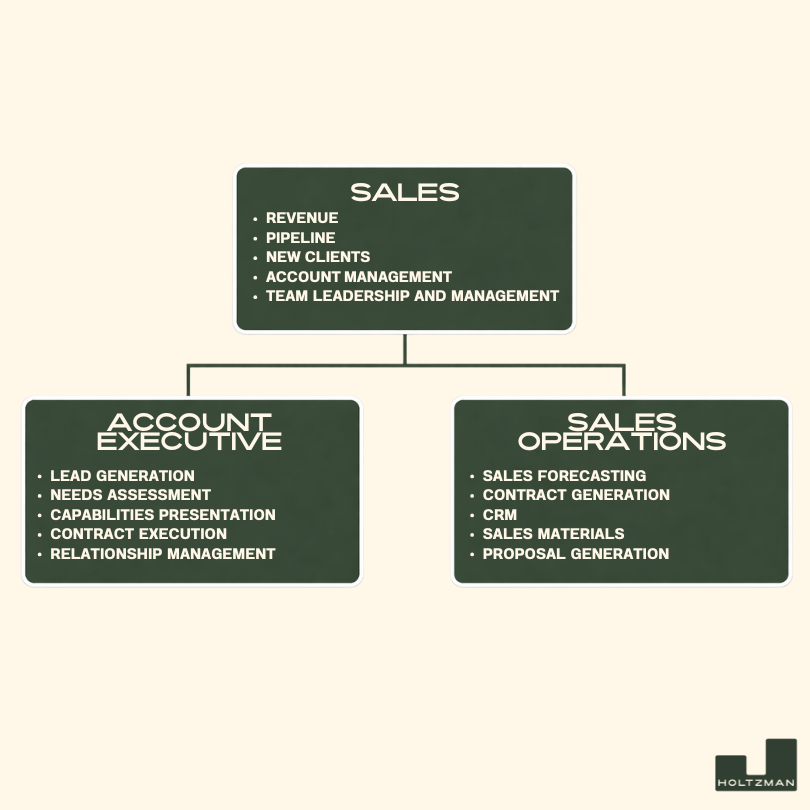
This reflects the EOS Accountability Chart concept: function-based structure that clarifies responsibility without relying on titles.
Measurables and success criteria are a separate discipline and should be handled just as deliberately.
This Is Not a Job Description
An accountability definition is not a replacement for a job description.
It is a prerequisite for one.
Leaders must align on the function and its accountabilities first. Only then does a job description add value. Without that alignment, more detail only masks confusion.
Clear roles do not come from more words.
They come from shared understanding of what must be owned.
When Titles Actually Matter
Titles matter. Just not where most leaders think they do.
Titles matter outside your organization. They signal authority to clients and partners. They provide context on LinkedIn, resumes, and conference panels. They create credibility in the market.
A VP gets calls returned. A Customer Service Representative gets screened. Same person, different access.
In the outside world, that signaling has value.
This is why eliminating titles entirely usually backfires. People are right to push back.
Problems arise when that external signaling is allowed to dictate internal structure.
That is where titles stop helping and start causing damage.
Titles Are Optional. Clarity Is Not.
That leadership team eventually saw the mistake clearly.
The work had never been defined. The title came first.
They parted ways with the original hire. Not because he failed, but because the role had never been clear.
This time, they did the work first. They defined the work, then labeled it. Only then did they return to the market.
The next hire succeeded for one simple reason.
Clarity came before the title.
Sources & Footnotes
Peter Drucker quote (“Rank does not confer privilege or give power. It imposes responsibility.”)
Commonly attributed to Peter F. Drucker and consistent with his broader body of work on management, responsibility, and executive accountability, including The Practice of Management (1954) and Management: Tasks, Responsibilities, Practices (1973). Exact phrasing varies across publications and lectures.
EOS® Accountability Chart concept
The Accountability Chart referenced in this article is part of the Entrepreneurial Operating System® (EOS®), as developed by Gino Wickman and outlined in Traction: Get a Grip on Your Business (2007). The concept emphasizes defining seats by function and accountability rather than by title.
Business Examples
All business examples and leadership patterns referenced are derived from my real-world experience coaching leadership teams across a wide range of industries and company sizes. Examples have been anonymized and generalized for educational purposes.
